
Double Seam
The first and second roller operations interlock and compress the lid and body flange into a multi-layer mechanical seam.
Deepack produces fully automatic Can Sealing Machine to free your hands and save your time. Choose the right one for your applications.
Request A Quote ›In Deepack, we offer a wide variety of automatic can sealing machines to free your hands and enhance efficiency. The following configurations cover automatic sealing, vacuum sealing and nitrogen filling. Explore the automatic can sealers below for can and jar sealing in various industries.
Automatic sealing equipment connects container feeding, lid placement and seaming within a production line. Select the configuration around the product, container and required output.
An automatic tin can seamer forms a mechanical seam between a compatible container and lid. Feeding and cycle control are automated; operators still manage setup, replenishment, cleaning and inspection.
Vacuum, nitrogen flushing and integration with filling or weighing equipment depend on the selected configuration.
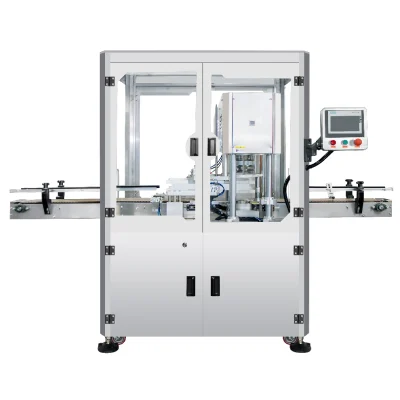
The rollers join the lid to the can body and compress the seam.
The chuck supports the lid against roller pressure and is matched to the can diameter.
The base plate supports the container during the sealing operation.
The lifting tray positions the container for the sealing cycle.
Vacuum and nitrogen configurations perform the process inside a sealed chamber.
The vacuum system removes air before nitrogen filling and sealing.
The operator sets and monitors the sealing cycle through the control panel.
Rotary designs turn the container during sealing. Non-rotary designs keep the container stationary to reduce movement of the contents.
The container and lid are positioned against the chuck before the rollers begin forming the seam.
The first operation folds the lid curl and body flange together to form the interlocking hooks.
The second operation compresses the interlocked layers to finish the double seam.
Overload protection helps prevent damage when a sealing cycle encounters excessive resistance. Confirm the protection and reset functions for the selected configuration.
Matched rollers and controlled container positioning form a consistent seam. Select the operating speed around the can, lid and product rather than speed alone.
Review the machine frame, contact surfaces and component materials against the intended production and cleaning conditions.
Automatic sealing configurations serve a range of products and containers. Container material, lid geometry and product characteristics determine the tooling and process requirements.
| Industry | Typical Products |
|---|---|
| Beverage Industry | Beer, juice, water, coffee, tea and carbonated beverages |
| Food Industry | Seafood, sauces, nutrition powders, nuts, cereals, vegetables and fruit |
| Pharmaceutical Industry | Powders and packaged supplies, subject to product-specific requirements |
| Chemical Industry | Lubricants, paint, ink, adhesives and cleaning products, subject to material compatibility |
Review the product, container material, production target and factory layout. Tooling, electrical components and machine size are selected for the intended configuration.
Discuss Your ApplicationSeam integrity depends on compatible containers, accurately matched tooling and a controlled sealing process.
The first and second roller operations interlock and compress the lid and body flange into a multi-layer mechanical seam.

Roller profile, rigidity and adjustment affect seam formation. Inspect the finished seam against the container specification.

Match the chuck, base plate and rollers to the dimensions and material of the can and lid.
Customer feedback content pending replacement.
Verified Deepack customer feedback will appear here.
Content pending
Verified Deepack customer feedback will appear here.
Content pending
Verified Deepack customer feedback will appear here.
Content pending
Contact Deepack with your can dimensions, lid type and target output.
owen@deepackmachinery.comWhats App: +86 18037891343 · WeChat: +86 18037891343